What CBD Can and Can’t Do for Sun-Damaged Skin
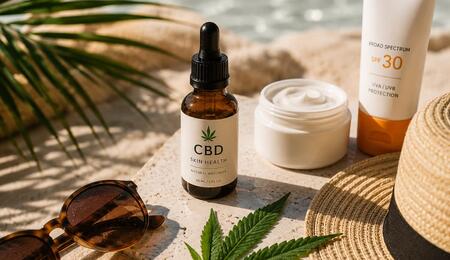
CBD-infused skincare products are increasingly being explored for their antioxidant and anti-inflammatory properties, making them a growing area of interest in post-sun skin recovery routines.
As summer temperatures peak, our relationship with the sun undergoes its annual calibration. While ultraviolet (UV) radiation is essential for synthesizing Vitamin D, overexposure triggers a cascade of cellular stress, resulting in localized erythema (sunburn), accelerated photoaging, and DNA damage.
While broad-spectrum SPF remains the non-negotiable frontline defense against UV radiation, dermatological research is increasingly focusing on secondary, therapeutic interventions to manage the skin’s inflammatory response. At the forefront of this molecular shift is cannabidiol (CBD).
Here is a scientific, data-driven look at how topical CBD interacts with your skin before and after sun exposure.
1. The Cutaneous Endocannabinoid System (ECS)
To understand how CBD influences sun-damaged skin, we must look beneath the stratum corneum. The human skin expresses a fully functional cutaneous Endocannabinoid System (ECS).
Keratinocytes, melanocytes, sebaceous glands, and sensory nerve endings all possess cannabinoid receptors (primarily CB1 and CB2), along with transient receptor potential (TRP) channels. The cutaneous ECS acts as a biological master regulator, constantly working to maintain homeostasis in the skin barrier by controlling cell growth, differentiation, and inflammatory responses.
When UV rays penetrate the skin, they disrupt this homeostasis. Topical CBD acts as an exogenous modulator, interacting with non-cannabinoid receptors like TRPV1 (which regulates pain, heat, and itching) and stimulating the body’s natural endocannabinoid levels to help mitigate the incoming stress on the skin.
2. Countering UV-Induced Oxidative Stress
The primary mechanism behind sun damage and long-term photoaging is the creation of Reactive Oxygen Species (ROS), that is unstable free radicals generated by UVA and UVB rays that break down structural collagen and elastin fibers. This leads to premature wrinkles, sagging, and hyperpigmentation.
CBD is considered to be a potent antioxidant. Its molecular architecture allows it to donate an electron to unstable free radical molecules, neutralizing them before they can trigger lipid peroxidation or degrade the skin’s matrix.
By scavenging ROS at a cellular level, topical CBD may help reduce some of the oxidative stress associated with long-term sun exposure.
3. CBD and the Post-Sun Inflammatory Response
An acute sunburn is essentially an inflammatory response triggered by the immune system to repair damaged skin cells. This process releases pro-inflammatory cytokines, causing blood vessels to dilate (resulting in redness) and sensitizing pain receptors.
Preclinical dermatological studies suggest that CBD may inhibit inflammatory pathways, notably suppressing nuclear factor kappa B (NF-κB), a primary signaling molecule responsible for turning on the body’s inflammatory response.
- Redness Reduction: By dampening cytokine production, CBD helps reduce the intensity of UV-induced erythema.
- Sensation Management: Through its interaction with TRPV1 receptors, CBD can desensitize the painful, stinging sensations associated with acute sunburns, offering localized relief without the systemic side effects of oral NSAIDs.
4. Formulating Smart: What to Look For
Not all CBD skincare products are engineered equally for sun care. To get true dermatological utility, look for specific formulation criteria:
- Broad or Full-Spectrum: These extracts contain a suite of minor cannabinoids and terpenes (like alpha-bisabolol and limonene) that may contribute complementary biological activity for a more soothing effect.
- Synergistic Botanical Carriers: Look for CBD paired with other dermatological soothing agents like aloe vera, hyaluronic acid, red raspberry seed oil (rich in natural antioxidants), or jojoba oil.
- Zero Artificial Fragrances: Sun-sensitized skin has a compromised lipid barrier. Avoid heavy artificial perfumes, alcohols, or essential oils that can provoke contact dermatitis on top of an existing sunburn.
CBD and THC come from the same plant, but CBD is non-intoxicating and affects the body through different biological pathways. Video source: Neuroscientifically Challenged, YouTube
FAQ: CBD and Sun Care
Can CBD help soothe sun-exposed skin?
Possibly. CBD has anti-inflammatory properties that may help calm redness, irritation, and discomfort after sun exposure.
How does CBD support sun-stressed skin?
Researchers believe CBD may help by reducing inflammation, combating oxidative stress, and supporting the skin’s natural barrier function.
Can CBD reduce redness from sun exposure?
It may. Studies suggest topical CBD could help lessen UV-related redness, though more research is needed.
Can CBD help prevent photoaging?
Potentially. CBD acts as an antioxidant, which may help neutralize free radicals that contribute to collagen breakdown and premature skin aging.
Can CBD replace sunscreen?
No. CBD is not a substitute for broad-spectrum sunscreen. It does not provide the proven UV protection offered by SPF-rated products.
Is CBD sunscreen better than regular sunscreen?
Not necessarily. Any benefits from CBD are considered an addition to the sunscreen formula, not an improvement in UV protection itself.
Should CBD be used before or after sun exposure?
Most commonly after. CBD is often included in post-sun skincare products designed to help soothe and hydrate sun-stressed skin.
Is the science settled on CBD and sun care?
Not yet. The early findings are very promising, but larger human studies are needed to confirm CBD’s complete role in sun care and skin recovery.
Read more from Soft Secrets:
- Is Cannabis Skincare Good for Your Skin?
- Topical Cannabis Products: How They Manage Skin and Localized Discomfort
- CBD for Acne and Healthy Skin
Medical Notice: Cannabidiol (CBD) is a secondary skincare supplement and is not a replacement for sunscreen. Topical CBD possesses no standalone Sun Protection Factor (SPF) and cannot shield the skin from UV radiation or prevent DNA damage associated with skin cancer. Always apply a broad-spectrum SPF 30 or higher before being exposed. If you experience severe, blistering sunburns, chills, or a fever, seek immediate medical attention from a licensed dermatologist or medical professional.
S
Stephen Andrews