Mastering Veg: Transplants and Pruning
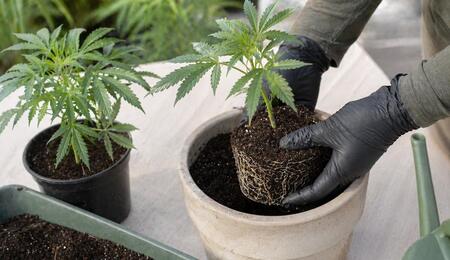
A properly timed transplant minimizes root stress and maintains uninterrupted vegetative growth momentum.
Sometimes, growers might not even notice small mistakes. A healthy plant gets moved to a bigger pot. A day later, it droops. Growth pauses. Leaves lose their edge. Nothing dramatic—just a quiet stall. But in a tightly controlled grow cycle, that “one bad day” compounds. A week later, the plant is behind. By harvest, the difference is measured in grams… or more.
Now flip that scenario.
The same plant is transplanted without stress, pruned with intent, and trained early. Instead of recovering, it accelerates. Every branch competes for light. Every node has a purpose. By the time flowering begins, the plant isn’t just bigger—it’s engineered.
That’s the real goal of advanced vegetation: not growth for its own sake, but precision. Structure. Efficiency. This is where transplanting and pruning stop being routine tasks, and start becoming strategic tools.
Crafting Your Plant: Better Veg, Better Buds
The vegetative stage isn’t about size, it’s about architecture.
Your objective is to build a plant that can:
- support heavy flower mass
- maintain airflow under dense canopies
- distribute light evenly across all bud sites
When transplanting and pruning are aligned, you reduce wasted energy, shorten veg time, and turn every input (light, nutrients, water, etc.) into productive growth.
Transplanting Without Setbacks: The Zero-Shock Approach
Transplant shock is one of the most underestimated yield killers. Even minor root disturbance can pause growth for days.
The Single-Transplant Strategy
Many growers today are moving plants directly from propagation into final containers (typically 5–7 gallons).
Skipping intermediate pots:
- eliminates recovery phases
- reduces root disturbance
- accelerates overall development
Less interruption = continuous growth momentum.
Building a Biological Buffer
As much as they need space, healthy roots also need support.
Incorporating:
- biochar-enriched substrates
- mycorrhizal fungi
- seaweed-based root stimulants
…creates a living interface that protects fine root hairs and improves immediate nutrient uptake after transplant.
Think of it as cushioning the landing rather than bracing for impact.
The Depth Rule (Often Ignored, Often Costly)
Never bury the stem deeper than its original soil line.
The crown zone requires oxygen. In modern high-moisture substrates, planting too deep increases the risk of stem rot and slows early root expansion.
Precision here prevents problems later.
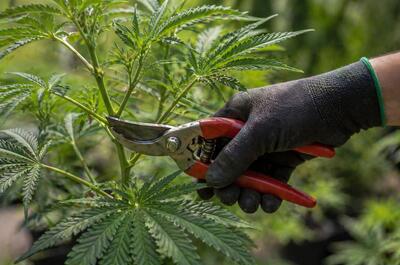
Strategic pruning redirects growth hormones, encouraging stronger branching and a more productive canopy.
Pruning as Hormone Management, Not Just Cleanup
Pruning, or removing leaves from the vegetative plant, is about redirecting growth signals.
Auxin, the hormone responsible for apical dominance, dictates where the plant invests energy. Carefully-thought cuts disrupt this hierarchy and redistribute growth across multiple sites.
Topping vs. FIMing: Choosing Your Growth Pattern
- Topping produces a clean, predictable split—ideal for symmetrical structures
- FIMing (removing ~75% of the tip) creates multiple new growth points with less stress
For growers aiming at dense, multi-cola canopies, FIMing is the answer toward bushier plant profiles.
Lollipopping: Airflow Is Yield Protection
As indoor humidity trends upward, airflow becomes critical.
Removing the lower 20–30% of foliage:
- eliminates unproductive growth
- improves air circulation
- reduces risk of diseases like Botrytis (bud rot)
If light can’t reach it, the plant shouldn’t be feeding it.
Canopy Control: The Flat-Top Advantage
One of the most overlooked upgrades in plant training is canopy uniformity.
By combining pruning with Low-Stress Training (LST), you reshape how the plant interacts with light.
The Flat Canopy Principle
Gently bending the main stem horizontally and securing it:
- breaks apical dominance naturally
- allows side branches to grow evenly
- creates a level canopy surface
The result: every bud site receives consistent light intensity (PPFD), rather than a few dominant tops overshadowing the rest.
Uniform light distribution = uniform development.
Final Thought
At a glance, pruning and transplanting look like routine maintenance. But done with intention, they become the difference between a plant that survives and one that performs.
In advanced cultivation, growth isn’t left to chance. It’s something you can actively engineer, and ultimately enjoy the results of your hard work.
Read more from Soft Secrets:
S
Stephen Andrews