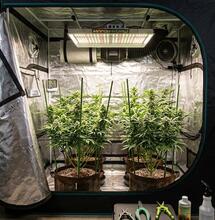
The Best Ways To Keep Your Indoor Grow Room Silent
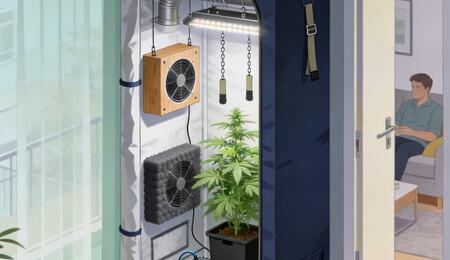
Have you ever entered a grow room so loud that you immediately thought your neighbours would hear you? What could you do to bring the noise levels down to a comfortable level? Keeping a grow room quiet is essential for discretion, comfort, and peace of mind, especially in residential environments.
Loud fans, vibrating equipment, and extracted air can quickly draw unwanted attention. In this article, I will explain how you can modify your grow room to operate much more quietly and discreetly, without costing much money.
LED Lights
Modern LED grow lights offer a significant advantage in passive cooling, reducing noise. These fixtures are designed to dissipate heat without internal fans, meaning they operate in near silence. Many older LED lights have internal cooling fans that can become noisy and grow louder over time.
In contrast, HPS and metal halide systems require ballasts and active cooling, which generate both heat and noise. Ballasts also lose efficiency as temperatures rise. Passively cooled LED lights convert more energy into usable light, produce less heat, and eliminate the constant hum of cooling fans altogether.
Fans Off the Floor
Good airflow is essential, but fans placed directly on the floor can cause vibration and reverberation throughout the building. When setting up your grow room, placing fans on a foam pad or insulated base helps absorb vibrations and reduce noise.
If using wall-mounted fans, be mindful of shared walls. The buzzing can readily travel through them. Using several smaller fans instead of one large unit is often quieter and just as effective at maintaining consistent airflow and preventing stagnant air pockets. Foam pads are an excellent option for oscillating fans, as they absorb vibration without affecting airflow.
Fan Speed Controllers
Adding a fan speed controller can make a dramatic difference in noise levels. By slightly reducing the power of the inline or exhaust fans, you lower the volume of air being moved and with it, the noise. These devices allow you to manually adjust the output using a dial mounted on the plug and work wonderfully when connected to your extractor or inline fan.
Speed controllers are inexpensive and offer multiple benefits: quieter operation, lower energy consumption, and the ability to fine-tune airflow to suit your environment. Even a slight reduction in fan speed can be enough to keep nearby neighbors undisturbed. Fan speed controllers are handy if you have an unexpected visitor and need to temporarily turn the grow room noise down as low as possible.
Install Acoustic Ducting
One of the simplest ways to reduce grow room noise is by upgrading your ducting. Standard aluminum ducting amplifies the sound of air as it passes through it. In contrast, acoustic (soundproof) ducting is insulated to absorb that noise.
When paired with a powerful exhaust fan, acoustic ducting reduces harsh airflow sounds to a softer, barely noticeable breeze. While it can cost up to 5 times as much as standard ducting, the investment is worthwhile. Air displacement and fan performance remain unchanged; you eliminate the loud rushing noise exiting the grow room. Using acoustic ducting and silencers on both sides of your exhaust fan significantly reduces noise.
Use Foam Pads for Air Pumps
When using hydroponic systems, you will need to install an air pump to create oxygen in your reservoir or DWC bucket. Air pumps can become loud and vibrate through floorboards. An easy way to combat this noise is to raise the air pump off the floor and place it on a thick foam pad to absorb sound and vibration.
You would be amazed at how much of an impact using a foam pad under your air pump has, and it won’t cost much. The last thing you want is for your neighbor to complain about the noise from the air pump left on 24 hours a day, so foam pads are a quick and effective way to resolve the issue.
Wooden Acoustic Boxes for Extractor Fans
Building or purchasing a soundproof box for your exhaust fan can drastically reduce noise. These boxes are typically made from wood and lined with acoustic foam similar to that used in recording studios. You can either buy a soundproof wooden box online or, if you are confident enough, build one using wood and acoustic foam.
Once installed, attach your acoustic ducting and hang the soundproof box inside the tent, or place it on the floor in the corner. Suspending it prevents vibration from transferring through tent poles, floors, or walls. When positioned correctly, the once-loud industrial fan noise becomes virtually inaudible outside the grow room. It can help give you the peace of mind that you are operating a discreet, stealthy grow space.
Silencers On Both Ends of the Exhaust Fan
Duct silencers are one of the most effective tools for reducing airflow noise before it exits the grow room. Lined with acoustic foam, silencers muffle sound as air passes through them, reducing the industrial bass that makes a grow room stand out to any neighbors.
Attach a silencer as close to the exhaust fan as possible. For especially loud extraction systems, installing a silencer on both the intake and exhaust sides of the fan can make a significant difference, bringing noise levels down to a minimum. When combined with acoustic ducting, you will find that even at maximum capacity, noise levels are much lower without sacrificing efficiency.
Hang Equipment Correctly
Improperly mounted equipment is one of the most common causes of excessive grow room noise. Using chains on metal tent poles often creates vibration and an irritating buzzing sound that can worsen over time. Grow tents can shake and vibrate through floorboards and onto neighboring walls.
Fans and other moving equipment should be securely mounted and allowed to hang freely without touching poles or rigid surfaces. For example, an RVK fan suspended with straps or bungee cords will be far quieter than one chained directly to a tent frame. Avoid placing fans or soundproof boxes directly on floors or attaching them to walls, especially in residential buildings.
Be Friendly with Your Neighbors
Whilst keeping your grow room as hidden as possible is the name of the game as an indoor grower, maintaining a good relationship with your neighbor is a good idea. The reason is that a happy neighbor will politely let you know that they have problems with the sound from your grow room.
From my experience as a home grower, keeping your neighbor sweet and speaking to them as often as possible will keep things running smoothly. An annoyed neighbor won’t think twice about calling the police or council on you, so do your best to maintain a good rapport with them, as it can pay off massively.
Smell Proof The Drying Tent
Whilst drying weed, may not be noise related, making sure that your drying area is smell proof is essential. There is no point in taking the time and effort to sound proof your grow room if for the final two weeks, the aroma in your house or apartment is so loud, that the smell begins to bother near by neighbors. My advice is to set up a separate grow tent with a carbon filter and extractor to keep the smell minimal. It may cost you a few hundred euros, however is well worth the investment.
The Benefits of A Quiet Grow Room
- Your neighbors will not be upset or even know you have a grow room
- Unexpected guests or visitors will not be aware that you have a grow space
- Growers living in apartments do not need to worry about vibrating floorboards or walls
- The equipment listed in this article only needs to be bought once
- You can exhaust air outside without it causing any unwanted attention due to noise
- You will have the peace of mind that your grow room is as silent as possible
S
Stoney.Tark