7 Iconic Musicians Who Shaped Modern Cannabis Culture
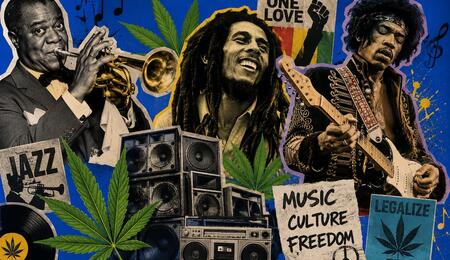
Musicians across jazz, reggae, rock, and hip-hop helped shape public conversations around cannabis long before legalization expanded across the United States.
While legalization ultimately required decades of political organizing and legal reform, musicians played a major role in shifting public attitudes toward cannabis. By bringing the subject into music, film, and everyday culture, they helped transform cannabis from a heavily demonized substance into a widely discussed social and political issue.
Between Rhythm, Rhyme, and Reform
Music has always been the frontline of cultural revolution. Long before state dispensaries and legal recreational markets became reality across much of the United States, cannabis found its loudest advocates not in political backrooms, but on stage.
During intense periods of federal prohibition, iconic musicians across various genres risked their careers, freedom, and public reputation to normalize the plant. By weaving cannabis into their lyrics, style, and public personas, these trailblazers transformed a deeply stigmatized counterculture element into a mainstream movement, forever changing how the world views cannabis.
1. Louis Armstrong: The Jazz Pioneer Who Fought Early Prohibition
The history of American cannabis culture is inseparable from the 1920s and 1930s jazz scene, and no one championed it more than Louis “Satchmo” Armstrong. In an era when the federal government was actively weaponizing anti-marijuana propaganda, Armstrong and his contemporary jazz musicians—affectionately known as “vipers”—used cannabis as a creative catalyst and a social equalizer.
Armstrong viewed cannabis not as a drug, but as a medicine and a source of peace. His support for cannabis was so strong that biographers later reported he even expressed pro-legalization views directly to President Dwight D. Eisenhower. Armstrong’s lifelong, unapologetic consumption laid the groundwork for decades of counterculture resistance, proving that cannabis advocacy was born alongside America’s greatest original art form.
2. Bob Marley: Integrating Rastafari and Global Cannabis Consciousness
In the 1970s, Bob Marley elevated cannabis from a subcultural pastime to a global spiritual phenomenon. Through reggae music, Marley introduced international audiences to the Rastafari faith, where ganja is revered as a sacred herb and a sacrament rather than a recreational substance.
Marley utilized his global platform to advocate for the plant, viewing it as a tool for political unity, personal insight, and systemic critique (“Babylon system”). Tracks like “Kaya” celebrated the plant openly, making cannabis an international symbol of peace, meditation, and resistance against oppression. Marley’s legacy ensures that cannabis culture remains deeply rooted in mindfulness and social justice.
3. Willie Nelson: The Country Icon and Bipartisan Advocate
Cannabis advocacy often crosses political divides, and no one embodies this better than country music legend Willie Nelson. For over half a century, Nelson has been the friendly, cross-generational face of cannabis normalization in the United States, proving that appreciation for the plant spans from inner-city hip-hop hubs to rural heartlands.
Nelson has also been a longtime supporter of cannabis reform, serving on NORML’s advisory board for decades. As the US recreational market matured, Nelson successfully transitioned from a counterculture icon into a legal market entrepreneur, launching his own commercial brand. His advocacy proved that cannabis legalization is a common-sense issue that unites Americans across the political spectrum.
4. Cypress Hill: The Hip-Hop Trailblazers of the 1990s
While the 1960s and 70s focused on peace and spirituality, the 1990s demanded an aggressive, unapologetic push for normalization. Enter Cypress Hill. With the release of their multi-platinum album Black Sunday (1993), the West Coast hip-hop group brought cannabis imagery, streetwear, and pro-legalization rhetoric straight into mainstream American living rooms.
Tracks like “Hits from the Bong,” alongside crossover hits such as “Insane in the Brain,” helped bring cannabis culture into the mainstream. Cypress Hill didn’t just sing about cannabis; they openly challenged cannabis stigma while promoting legalization and criticizing the racial inequalities of the War on Drugs. They normalized the aesthetic of cannabis culture, making it an undeniable force in modern pop culture.
5. Snoop Dogg: From Counterculture Icon to Legal Market Mogul
If cannabis culture had a single global ambassador, it would be Snoop Dogg. Rising to fame during the early 1990s G-Funk era alongside Dr. Dre, Snoop made his affinity for the plant a core pillar of his musical identity. His lyrics turned smoking cannabis into a symbol of West Coast cool.
Snoop’s true impact, however, lies in his evolution alongside the legal framework. As states began opening legal dispensaries, Snoop became one of the first globally recognized entertainers to launch a major legal cannabis brand. His journey from being targeted by law enforcement to partnering with mainstream lifestyle brands exemplifies the historic shift of cannabis from a criminalized counterculture element to a multi-billion-dollar legal industry.
6. Jimi Hendrix: Soundtrack to the Psychedelic Revolution
The late 1960s counterculture movement was fueled by a desire to challenge authority, stop wars, and expand consciousness. Jimi Hendrix provided the definitive soundtrack to this era. His unmatched guitar wizardry and psychedelic rock style became forever synonymous with the sensory and artistic exploration of cannabis.
While songs like “Purple Haze” have been debated for their literal lyrical intent, the cultural impact was undeniable: Hendrix’s music became the sonic backdrop for the Woodstock generation. He helped frame cannabis consumption not as a destructive habit, but as a tool for creative liberation, profound artistic expression, and peaceful assembly.
7. Method Man & Redman: The Duo That Defined Stoner Cinema and Lifestyle
As the cannabis movement entered the late 1990s and early 2000s, East Coast hip-hop icons Method Man and Redman brought a vital element to the culture: humor, camaraderie, and accessible lifestyle representation.
Through their collaborative music tracks and their cult classic film How High (2001), the duo redefined the “stoner lifestyle” for the modern era. They stripped away the dark, secretive taboos often associated with consumption, replacing them with a friendly, lighthearted, and highly collaborative community spirit. Their work cemented cannabis as a staple of modern comedy and urban lifestyle, showing that the plant brings people together through laughter and shared experiences.
From the Stage to the Dispensary: A Legal Evolution
The cultural landscape seen today—where adults can legally purchase cannabis from licensed dispensaries across much of the United States—was shaped not only by lawmakers and activists, but also by musicians who challenged long-standing stigma through their art and public personas. From underground jazz clubs in the 1920s to stadium tours and mainstream media in later decades, these artists helped normalize cannabis in popular culture and encouraged broader conversations around prohibition, creativity, and personal freedom.
Read more from Soft Secrets:
Disclaimer: The information presented in this article is for informational and journalistic purposes only. Soft Secrets does not encourage or endorse illegal consumption. Readers should check their local state laws regarding legal age limits and licensing requirements before visiting dispensaries or purchasing cannabis products.
S
Stephen Andrews