USDA Backs Two-Year Hybrid Hemp Trials to Test Oilseed Potential
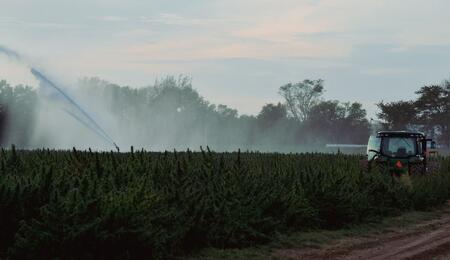
Tractor irrigating a field of crops at dusk. Across the U.S., corn and soybeans occupy roughly 166 million acres annually, prompting federal researchers to test hybrid hemp as a high-oil rotation crop. Photo by Trent Haddock on Unsplash
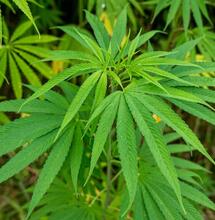
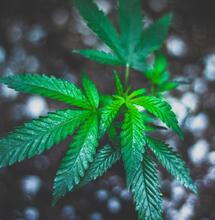
The U.S. Department of Agriculture is funding a two-year research project to test whether hybrid hemp can serve as a profitable, high-yielding oilseed alternative to America’s dominant corn-and-soybean rotations.
Through its National Institute of Food and Agriculture (NIFA), the agency awarded $459,825 to Fort Collins, Colorado-based seed breeder New West Genetics Inc. under the Supplemental and Alternative Crops program. Led by project director R. Fletcher, the study runs from September 15, 2026, through September 14, 2028.
Breaking Up the Corn-and-Soy Rotation
Across the United States, farmers plant roughly 166 million acres of corn and soybeans each year, accounting for nearly 57% of total U.S. crop production. Relying so heavily on two crops leaves growers exposed to price swings as well as mounting pest and disease pressures caused by repetitive planting cycles.
Industrial hemp has long been floated as a sustainable rotation crop that improves soil health, yet low grain yields have kept production costs high and hindered commercial adoption. Conventional hemp fields typically split evenly between male and female plants, meaning half the crop produces pollen instead of seed. New West Genetics says its non-GMO hybrid varieties, which skew roughly 90% female, can double grain yields compared to traditional varieties. The federal trials are designed to put that claim to the test across different climates.
Three Core Research Goals
To evaluate whether hybrid hemp can compete alongside mainstream commodity crops, researchers have structured the project around three main objectives:
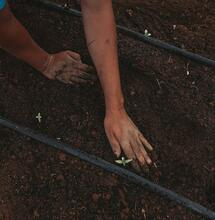
- Double-Cropping and Yield Performance: At test sites across Colorado, Kansas, Illinois, and North Carolina, researchers aim to plant eight hybrid hemp varieties alongside two traditional open-pollinated varieties for comparison. Planting is scheduled to take place during two seasonal windows: early spring (February to April) and mid-summer (late June to mid-July), following winter wheat or canola harvests. Teams will track germination, flowering, plant height, maturity, and total grain yield.
- Drought and Disease Resilience: At Colorado State University’s Agricultural Research, Development and Education Center (ARDEC), researchers will grow 10 hybrids alongside their 12 parent lines under both standard irrigation and severe drought conditions, cutting water by half in the stressed plots. Plants will also undergo laboratory screening for beet curly top virus, a damaging crop disease spread by insects.
- Farmer Education and Outreach: The project includes field days, university Extension factsheets, train-the-trainer workshops, and an online hemp resource portal hosted by North Carolina State University to help growers evaluate the economics of adding hemp to their rotations.
Testing a Soybean-Style Supply Chain
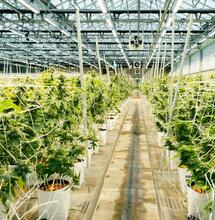
Beyond field plots, the project will run larger on-farm trials of 5 to 10 acres in North Carolina and Kansas using real-world double-crop schedules. Grain harvested from those fields will be purchased and sent through pilot-scale commercial processing, including dehulling, cracking, flaking, conditioning, and solvent oil extraction.
While extracting oil from hempseed using solvents is already known to work, this would be the first pilot-scale demonstration showing that hemp grain can move smoothly through existing soybean-style processing infrastructure. That scalability could open major new end markets beyond food and protein ingredients, as fuel producers increasingly look for low-carbon oilseed feedstocks to supply renewable biofuels. New West Genetics has noted that its newest hybrids can produce more oil per acre than soybeans in certain rotations, making the crop an attractive candidate for emerging biofuel supply chains.
The multi-state effort brings together researchers from Kansas State University, the University of Illinois Urbana-Champaign, North Carolina State University, and USDA Agricultural Research Service laboratories. Harvested grain will also undergo nutritional and oil-profile testing at the National Center for Agricultural Utilization Research.
Read more from Soft Secrets:
Disclaimer: Content published on this page is for journalistic and/or educational purposes only, and it should not replace professional medical or legal advice.
S
Stephen Andrews