What Is GPR55? The “CB3” Cannabinoid Receptor Explained
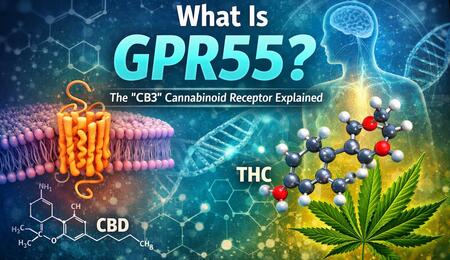
The term “CB3 receptor” is informal and not universally accepted in the scientific community, and much about it remains to be discovered.
For years, the science of cannabis seemed relatively straightforward: cannabinoids like THC and CBD exert their effects primarily through two receptors, CB1 and CB2. But as research has advanced, this simplified model has expanded. Scientists have identified additional signaling pathways and receptors that may help explain why cannabis produces such diverse and sometimes unexpected effects.
One of the most discussed among these is GPR55 — a receptor that interacts with certain cannabinoids but does not neatly fit into the traditional endocannabinoid system. Sometimes referred to informally as “CB3,” GPR55 remains a subject of ongoing research and debate. Understanding what it is — and what it is not — can help clarify both the potential and the limits of cannabinoid-based therapies.
Beyond CB1 and CB2: Understanding the GPR55 Receptor
Historically speaking, cannabis research has focused primarily on CB1 and CB2 receptors. CB1 is abundant in the central nervous system and is largely responsible for the psychoactive effects of THC, while CB2 is more closely associated with immune function and inflammation.
GPR55 (G protein-coupled receptor 55) was identified in the early 2000s as part of a broader family of receptors involved in cellular signaling. While it shares only limited structural similarity with CB1 and CB2, researchers observed that certain cannabinoids can interact with it. This led to the informal label “CB3,” though it is important to note that GPR55 is not officially classified as a cannabinoid receptor.
Instead, GPR55 is better understood as a cannabinoid-responsive receptor — one that may participate in some of the physiological effects associated with cannabis, without being part of the classical endocannabinoid system.
How Does GPR55 Work? Mechanisms and Cannabinoid Interactions
GPR55 is expressed in a wide range of tissues, including the brain, gastrointestinal tract, bones, and parts of the immune system. Its natural (endogenous) ligands are still being studied, but compounds such as lysophosphatidylinositol (LPI) are believed to activate it.
Interaction with CBD
Cannabidiol (CBD) appears to act as an antagonist at GPR55. In practical terms, this means it may reduce or block the receptor’s activity. This interaction has been explored in preclinical studies related to:
- Regulation of inflammatory signaling
- Modulation of blood pressure
- Bone metabolism
However, these findings are still largely derived from laboratory and animal models, and clinical evidence in humans remains limited.
Interaction with THC and Other Cannabinoids
Δ9-tetrahydrocannabinol (THC) may also interact with GPR55, although its primary effects are mediated through CB1 and CB2 receptors. Other cannabinoids, both plant-derived and synthetic, have shown varying degrees of activity at GPR55 in experimental settings.
At present, the exact role of GPR55 in shaping the overall effects of cannabis is not fully understood, and likely depends on dose, cannabinoid profile, and tissue-specific expression.
Why GPR55 Matters: Potential Medical Relevance
Interest in GPR55 has grown because of its involvement in several physiological processes that are relevant to human health. While the research is still evolving, several areas stand out:
Cancer Research
GPR55 is overexpressed in certain types of cancer cells, including some breast and gastrointestinal cancers. Early-stage studies suggest that reducing GPR55 activity may slow tumor cell proliferation. These findings are preliminary and should not be interpreted as evidence of clinical efficacy, but they highlight a potential pathway for future therapies.
Inflammation and Pain
GPR55 appears to play a role in inflammatory signaling and pain perception. This has led researchers to investigate whether targeting the receptor could contribute to the development of non-opioid pain treatments. The exact mechanisms, however, are still under investigation.
Bone Health
One of the more consistent findings is GPR55’s involvement in bone physiology. It may influence the balance between bone formation and resorption. Some experimental models suggest that blocking GPR55 activity could help reduce bone loss, which may have implications for conditions such as osteoporosis.
A Developing Area of Cannabinoid Science
GPR55 represents an important example of how cannabis research continues to evolve beyond its early frameworks. While CB1 and CB2 remain central to our understanding, receptors like GPR55 suggest a more complex network of interactions that may help explain the wide-ranging effects of cannabinoids.
At the same time, much about GPR55 remains unresolved. Its classification, mechanisms, and clinical relevance are still being studied, and conclusions should be drawn cautiously. For now, it is best understood not as a confirmed “third cannabinoid receptor,” but as a promising and actively researched component of the body’s broader signaling system.
Read more from Soft Secrets:
- The Story of Cannabis: A Complete Guide to History, Science, and Modern Use
- Cannabinoids Versus Terpenes - Who Does What?
- Cannabis and Adaptogenic Herbs: a Powerful Combination?
Disclaimer: This article covers advanced cannabinoid science and is for educational and journalistic purposes only. It is not a substitute for professional medical advice.
S
Soft Secrets