The Evolutionary Origin of THC and CBD Revealed
Where do cannabinoids come from? It’s a great question! In a breakthrough that sounds like the botanical version of Jurassic Park, researchers have “resurrected” ancient enzymes to solve a 30-million-year-old mystery: how did the cannabis plant learn to produce THC, CBD, and CBC?
Researchers Looked for Ancestor Compounds in Weed
For decades, we’ve known that modern cannabis uses specific, highly specialized enzymes to convert precursors into the cannabinoids we love. However, a new study published at the end of 2025 in the Plant Biotechnology Journal reveals that the plant’s ancestors weren’t so precise.
Researchers at Wageningen University & Research (WUR) in the Netherlands, led by Robin van Velzen and Cloé Villard, used a technique called ancestral sequence reconstruction. By analyzing the DNA of modern strains, they were able to “rewind” the evolutionary clock and recreate enzymes that haven’t existed in nature for millions of years.
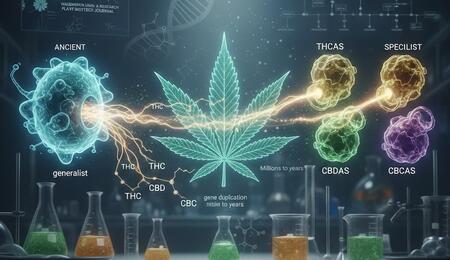
The discovery? It turns out ancient cannabis enzymes were “promiscuous generalists.” Instead of making just one compound, a single ancient enzyme would produce a “cocktail” of THC, CBD, and CBC all at once.
From Generalists to Specialists: A 30-Million-Year Journey
While the broader Cannabaceae family began its evolutionary journey roughly 30 million years ago, the unique chemical signature of the cannabis plant specifically was forged much later through a series of ‘genetic accidents.’ The study explains that as cannabis evolved, a process called gene duplication occurred. The plant essentially “copied and pasted” its genetic code. This allowed the extra copies of these generalist enzymes to mutate and specialize.
Over millions of years, these “clones” evolved into the high-efficiency “specialists” we see today:
- THCAS (THC-acid synthase)
- CBDAS (CBD-acid synthase)
- CBCAS (CBC-acid synthase)
Why This Matters for Growers and Patients
This isn’t just a history lesson—it has massive implications for the future of Medical Marijuana (MMJ) and the Rec Market:
- Sturdier Lab-Grown Cannabinoids: The researchers found that these “resurrected” ancestral enzymes are surprisingly robust and flexible, able to function smoothly inside microbes such as yeast or bacteria—something modern enzymes struggle with. Which makes them perfect for “cellular agriculture,” where cannabinoids are produced in yeast or bacteria instead of fields.
- The Rise of CBC: One specific “intermediate” enzyme discovered in the study is incredibly efficient at producing CBC (Cannabichromene). Since CBC is prized for its anti-inflammatory potential but is rarely found in high concentrations in modern flower, this “ancient” enzyme just might be the key to breeding new high-CBC medicinal strains.
As study author Van Velzen noted, “What once seemed evolutionarily ‘unfinished’ turns out to be highly useful.”
More from Soft Secrets:
- South Korean Researchers Discover New Cannabinoid
- Cannabinoids Versus Terpenes - Who Does What?
- How Do Cannabinoids Change After Drying?
Note to readers: This article covers scientific and research news. While these discoveries may lead to new medical applications, always consult with a healthcare professional before using cannabis for specific health conditions.
S
Stephen Andrews