What Is a Cannabis Tolerance Break and How to Do It Right

Stepping away from cannabis allows CB1 receptors to recover, restoring sensitivity and reducing the need for higher doses.
If you’ve noticed that your favorite strain doesn’t hit the same way it used to, or you’re spending twice as much at the dispensary to achieve the same effects, you’ve likely hit a “tolerance wall.” The well-known solution for it is taking a T-break (Tolerance Break) from cannabis. While often discussed as a simple test of willpower, a T-break is actually a strategic biological intervention.
Thanks to the newest neurobiological research, we now know exactly how the brain recovers when we pause our cannabis consumption. You may benefit from a tolerance break if you find yourself using cannabis more frequently or in higher amounts than usual, yet struggling to achieve the same effects.
The Science of the ‘Reset’
The primary reason for cannabis tolerance is the downregulation of CB1 receptors. These receptors are part of your Endocannabinoid System (ECS) and are responsible for processing THC.
When you consume high-potency cannabis daily, your brain tries to maintain balance by “turning off” or reducing the number of these receptors. This is why you need more THC to feel the same effect—there are simply fewer “docks” available for the molecules to land on.
Research published in Biological Psychiatry shows that:
- The 48-Hour Mark: CB1 receptors begin to “upregulate” (wake back up) within just two days of abstinence.
- The 4-Week Mark: For heavy users, it takes approximately 28 days for receptor density to return to levels nearly identical to those of non-smokers.
How Long Should Your T-Break Be?
Not every break needs to be a month long. Depending on your goals, you can choose a specific “reset level”:
- The Mini-Reset (48 to 72 Hours): Ideal for occasional users who want to clear a “brain fog” or lower their immediate dosage.
- The Half-Life Break (2 Weeks): This is the sweet spot for many. It allows for significant receptor recovery and clears most of the THC metabolites from your system.
- The Full Biological Reset (30 Days): Recommended for daily, long-term smokers or those experiencing Cannabis Withdrawal Syndrome (CWS). This is the only way to return your ECS to its true baseline.
Some cannabis users might find the first week of the T-Break particularly difficult. Deep dive here to find out more why pausing or giving up pot after years of use might feel so miserable.
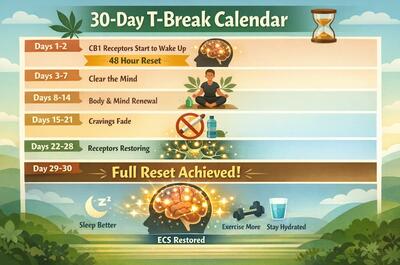
A 30-day tolerance break allows CB1 receptors to recover gradually, helping restore cannabis sensitivity and reduce long-term tolerance.
It Is Easier Said Than Done, But You Can Do It
A T-break shouldn’t be a period of suffering; it should be a period of optimization. Instead of constantly thinking that you won’t be smoking any weed tonight or until the rest of the month, your focus should be on how to live better during those days. There’s in fact plenty you can do.
- Hydration & Terpenes: Drink plenty of water and eat foods rich in beta-caryophyllene (like black pepper or cloves), which can interact mildly with CB2 receptors to help soothe anxiety without the “high.”
- Physical Activity: Exercise releases anandamide (our “internal THC”), which helps bridge the gap while the receptors are waking up.
- The Sleep Factor: Be prepared for vivid dreams (REM rebound). Instead of fighting them, view them as your brain’s way of catching up on months or (in some cases) years of suppressed dream cycles.
If you watch your favorite movie every month, it eventually loses its magic. Step away for a while, and the experience feels fresh again. Cannabis works the same way. A T-break isn’t about deprivation—it’s about preservation. By managing your tolerance, you protect long-term enjoyment of your favorite herb and keep cannabis a functional, intentional part of your life rather than an increasingly costly habit.
More from Soft Secrets:
S
Soft Secrets