10 Strictest Cannabis Laws: Travel Warning & 2025 Penalties Update
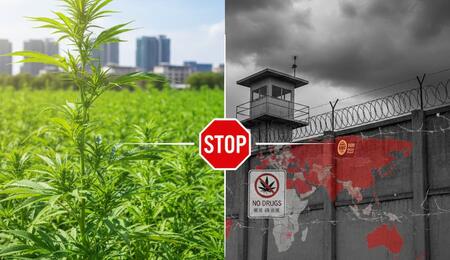
In some of the strictest countries, like the UAE, you can be arrested, charged, and imprisoned for possession if forensic tests find trace amounts of THC in your blood or urine, even if you consumed it legally in your home country weeks before traveling.
While many Western nations are embracing cannabis reform and moving toward legalization, there are still numerous countries across the globe that maintain a strict, zero-tolerance policy. In these regions, being caught with even a small amount of cannabis can result in mandatory prison sentences, massive fines, or, in the worst cases, the death penalty. So, let’s see where in the world you’d rather not get caught with weed.
Before booking your next trip, take a moment to review this updated guide on the world’s most hardcore anti-cannabis jurisdictions. Ignorance of the law will not prevent you from facing the harshest of punishments.
Southeast Asia: Zero Tolerance (The Death Penalty Risk)
Southeast Asia is, without question, the most dangerous region in the world for cannabis use. Several nations here retain the death penalty for drug trafficking offenses, and possession is often met with long, brutal prison sentences.
Singapore: The Death Penalty & Zero Tolerance
Singapore maintains a strict zero-tolerance policy against all drugs, including cannabis. It is perhaps the most famous example of severe drug laws. The Central Narcotics Bureau is highly vigilant, and punishments are swift and non-negotiable.
- Possession: Carrying small amounts can lead to 10 years in prison and a fine of up to $20,000.
- Trafficking: The death penalty is mandatory for trafficking over 500 grams of cannabis.
Indonesia (Bali): Prison Sentences for Any Type of Substance
Despite being a major tourist destination, especially for Australians and Europeans, Indonesia’s laws are extremely severe. The government does not distinguish between soft and hard drugs. Anyone caught with drugs is viewed as a drug trafficker.
- Possession: Minimum of four years in prison for personal use.
- Trafficking: Up to 15 years, or even the death penalty.
Philippines: Severe Prison Sentences for Possession
While the country’s high-profile “war on drugs” has seen some shifts in enforcement, the legal framework remains rigid. The 2002 Comprehensive Dangerous Drugs Act prescribes harsh penalties for cannabis offenses.
- Possession: Penalties depend on the quantity involved. Larger amounts can lead to life imprisonment and massive fines, while even smaller, personal-use quantities can still result in lengthy prison sentences, often exceeding a decade, particularly when aggravating factors are present.
Malaysia: Long Sentences and Corporal Punishment
Like its close neighbors, Malaysia imposes lengthy jail terms and heavy fines for cannabis possession. Sentences can include caning, a form of corporal punishment that is still legally permitted and enforced in certain drug-related cases.
- Important Update: Malaysia was long known for mandatory death sentences for drug trafficking, however, judicial discretion was introduced in 2023. This allows courts to impose long prison terms instead of automatic capital punishment. Nevertheless, cannabis trafficking remains a serious offense, with penalties that can still include decades in prison.
Brunei: Sharia Law and the Death Penalty
This small, wealthy Southeast Asian country follows an interpretation of Sharia law, viewing the use of drugs as a serious sin. As a Class A drug, the penalties for cannabis are severe.
- Penalty: The laws are clear and enforced; cannabis offenses will result in mandatory caning and long prison sentences (up to 30 years).
- Trafficking: Punishable with the death penalty.

In Southeast Asian nations such as Singapore, the mandatory death penalty is triggered if you are caught trafficking cannabis above a specific weight threshold (e.g., 500 grams). This is equivalent to about 17.6 ounces, an amount that can be packaged small enough to fit in a backpack.
The Gulf States: Absolute Prohibition & Recent Reforms
The Arabian Peninsula traditionally treats drug offenses with maximum severity. However, there has been a critical and recent reform in the UAE that travelers must understand.
United Arab Emirates (UAE): Limited Leniency for Trace Amounts
The UAE previously carried a reputation for extremely harsh punishments, including automatic jail time for trace amounts of cannabis or THC products. This reputation has been slightly softened by recent legal reforms, but those changes are applied only in very limited circumstances.
- The Reform (2021–2024): In limited cases, non-resident foreigners caught with trace or residual amounts of THC products at ports of entry may face fines instead of mandatory jail sentences, particularly for first-time offenses.
- Penalty: Fines range from AED 5,000 to AED 20,000 for first-time offenders. Confiscation remains mandatory, and deportation is still possible.
- The Warning: While the punishment is now often financial, authorities are still zero-tolerance. Trafficking, dealing, or possession of larger amounts within the country remains extremely severe, often resulting in years in prison. Travelers should not interpret these changes as decriminalization.
Saudi Arabia: Crime Against God
Cannabis use is treated as a severe moral and religious crime. The legal system operates under Sharia Law, where penalties are non-negotiable and often opaque.
- Penalty: Guaranteed imprisonment, corporal punishment (lashing), and, for trafficking, the death penalty is common.
Continental Europe: The Hardline Prohibitionist Anomaly
While Europe is generally liberal, some countries still retain very harsh, Cold War-era drug laws.
Slovakia: Still One of Europe’s Harshest
Slovakia remains an outlier in the European Union, where cannabis laws are disproportionately harsh.
- The Nuance: Following EU alignment, CBD products derived from industrial hemp are now legal and de-scheduled in Slovakia.
- The Danger: High-THC cannabis remains illegal, and possession is treated as a criminal offense rather than an administrative violation. Even small, personal-use quantities can lead to felony charges and lengthy prison sentences, with penalties escalating significantly for repeat offenses or larger amounts.
The World’s Deadliest Jurisdictions – China and Iran
These two nations stand out due to their high volume of drug-related executions, making them arguably the most dangerous places for foreigners caught dealing or trafficking.
Iran: Flogging, Execution, and Zero Tolerance
Iran has one of the highest execution rates for drug offenses globally. Under its strict interpretation of law, cannabis is treated as a serious crime.
- Penalty: Simple possession can result in corporal punishment (flogging) and years of imprisonment. Trafficking of substantial quantities is often penalized with the death penalty.
China: Maximum Penalty for Trafficking
China maintains strict control over drug offenses, and its legal system operates with extreme severity for trafficking.
- Penalty: Trafficking and large-scale manufacturing of cannabis carry a guaranteed severe penalty, often leading to life imprisonment or the death penalty for amounts exceeding 50 kilograms. Foreign nationals are not exempt from these punishments.
Conclusion: The Only Safe Approach
The contrast between the liberalized markets in the USA and Canada and the absolute prohibition in these 10 countries could not be starker. For those traveling internationally, the only safe approach is zero-tolerance and zero-possession in any jurisdiction outside of confirmed, federally legal states. The risk of losing your freedom—or your life—is simply too high.
Read more from Soft Secrets:
DISCLAIMER: The information presented in this article is for informational purposes only and it does NOT amount to legal advice. Cannabis laws change frequently and rapidly. The penalties described are extremely severe. Soft Secrets urges all readers to verify all current local laws with the relevant governmental authority before traveling to or possessing cannabis (even CBD) in any of these regions.
S
Stephen Andrews