Supreme Court to Weigh Federal Gun Ban for Marijuana Users
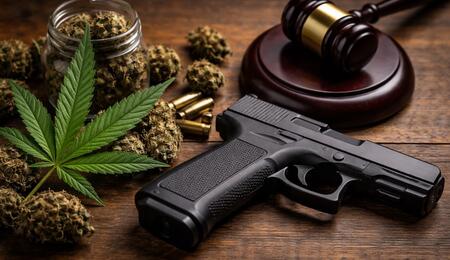
The Supreme Court of the United States is preparing to decide whether a federal law prohibiting marijuana users from possessing firearms is constitutional—a case that could significantly alter the legal landscape at the crossroads of gun rights and cannabis reform. At the center of the dispute is a decades-old statute that has gained new relevance as marijuana legalization expands across the country.
The Federal Law in Question
The legal challenge targets a provision of the Gun Control Act of 1968, specifically 18 U.S.C. § 922(g)(3). The statute makes it unlawful for any “unlawful user of or addicted to any controlled substance” to possess firearms or ammunition.
Because marijuana remains classified as a Schedule I drug under federal law, cannabis users—including those in states where recreational or medical use is legal—fall under this prohibition. The federal classification creates a legal contradiction: conduct permitted under state law can still trigger federal firearm restrictions.
The Supreme Court Case
The issue is now before the Court in United States v. Hemani, with oral arguments scheduled for March 2, 2026. Authorities alleged that the defendant was a regular marijuana user while also possessing a firearm.
Hemani argues that the statute violates the Second Amendment because it broadly disarms individuals based solely on cannabis use, without requiring proof that they are dangerous or impaired at the time of gun possession. His legal team contends that, under the Supreme Court’s modern Second Amendment framework, the government must demonstrate a historical tradition of comparable firearm restrictions—something they say does not exist for disarming ordinary citizens based on drug use alone.
Federal prosecutors counter that the law fits within longstanding traditions of firearm regulation and serves legitimate public safety interests by limiting access to guns among individuals who may be impaired.
The Court’s analysis is expected to be shaped by its 2022 decision in New York State Rifle & Pistol Association v. Bruen, which strengthened constitutional protections for gun ownership and established a “historical tradition” test for evaluating firearm regulations. Under that framework, modern gun laws must be consistent with historical limits dating back to the nation’s founding era.
Legal and Political Implications
Lower federal courts have split on whether disarming marijuana users meets the Bruen standard. Some judges have questioned whether there is sufficient historical precedent for broadly prohibiting firearm possession based solely on drug use. Others have upheld the law as comparable to longstanding restrictions on firearm access for certain categories of individuals.
The case has generated uncommon political alignments. Some civil liberties advocates and gun rights organizations argue that the law sweeps too broadly, while federal officials defend it as a reasonable safeguard.
If the Supreme Court strikes down or narrows the provision, the ruling could affect millions of Americans who legally consume cannabis under state law. It may also invite further challenges to other federal firearm prohibitions.
A Broader Tension Between State and Federal Law
The dispute underscores the continuing tension in U.S. policy: while a majority of states permit some form of marijuana use, federal law continues to treat cannabis as an illegal substance. Until Congress amends federal drug scheduling or the Court alters the constitutional analysis, marijuana users remain subject to federal firearm restrictions.
A decision is expected later in the Court’s current term. Whatever the outcome, the ruling is likely to have lasting consequences for both Second Amendment jurisprudence and the evolving landscape of cannabis legalization.
More from Soft Secrets:
S
Stephen Andrews