Sponsored
Medical Cannabis in the U.S.? How To Know If You Qualify

Medical cannabis is now legal in most parts of the U.S. According to the Marijuana Policy Project, 41 states plus D.C. have effective medical cannabis laws as of 2026, although a handful only allow low-THC products.
But whether you're in New York, Colorado, Florida, or any other state where medical marijuana is legal, having a health condition doesn't automatically qualify you. Eligibility still depends on your state's laws.
So, how can you tell whether you qualify? That's what this guide is about.
What Medical Conditions Qualify for Medical Cannabis?
Qualifying conditions are the health issues your state has approved for cannabis treatment. There is no uniform list of qualifying conditions; however, health departments of different states tend to agree on several core health challenges. Commonly recognized conditions include:
- Cancer
- Epilepsy and seizure disorders
- Multiple sclerosis
- Glaucoma
- PTSD
- HIV/AIDS
- Crohn's disease
- Chronic pain
Some states also have what's known as a catch-all rule. It lets a physician recommend cannabis for other “debilitating” or comparable conditions. That gives doctors more room to use their judgment.
However, even if you are diagnosed with a condition, it is up to a doctor to determine whether it would be reasonable to recommend medical cannabis. It's worth mentioning here that people actually want fewer restrictions for marijuana use. In fact, a 2024 Pew Research Center survey found that 88% of U.S. adults believe that marijuana should be made legal for medical or recreational purposes.
Beyond Medical Conditions: Other Eligibility Requirements
Your condition is just one piece when it comes to qualifying for medical cannabis use. Other requirements that determine if you’re eligible for medical marijuana use in the 41 U.S. states are:
- Age: Many states require patients to be 18 years or older. Minors may qualify in certain circumstances, generally with permission from parents or guardians. In such cases, additional medical supervision will likely be required.
- Residency status: Some states require proof of residency. Some also accept visitors who already have valid medical cannabis cards from their state. It is best to research whether your card from another state will be accepted in the state you're visiting.
- Medical evidence: You may need to provide evidence of your health condition, such as your medical history, diagnosis, or treatment history. This allows your doctor to make an informed recommendation.
- Doctor assessment: A health professional authorized to recommend medical cannabis in your state must assess you. A diagnosis alone doesn't mean you'll qualify.
These requirements differ from state to state. Texas, for example, operates a low-THC medical cannabis program through its Compassionate Use Program and doesn't issue the traditional physical medical marijuana card used in many other states.
How to Find Out If You Qualify for Medical Cannabis
Start by checking the official list. Visit your state health department's website and look for the section on medical cannabis that lists the qualifying conditions.
If your diagnosis or condition matches any on the list, that's great. If not, check whether your state has a catch-all category such as ‘debilitating condition'. Once you find your condition listed there, the next thing is to find a physician who can evaluate you.
Technology has made this part very easy. A platform like MedCard, for example, connects you with doctors online, which can be very helpful if your condition makes it difficult for you to do a lot of moving around.
Just remember that an online consultation isn't a guarantee. The doctor still has to agree that cannabis is appropriate for you.
Understanding State-Specific Rules
While there are places where an online consultation with a qualified physician is okay, some states insist on physical, in-person examinations. One example is Florida.
The state signed House Bill 387 in June 2023, and it took effect July 1, 2023. This bill requires that anyone who wants to be listed in Florida's medical marijuana registry has to do an in-person physical examination with a qualified physician first.
Once everything checks out, the doctor will issue your physician certification and enter your details into the MMUR. This is a non-negotiable step when it comes to getting a medical marijuana card online in Florida.
Renewals are easier. A renewal exam can happen through telehealth, as long as the same physician did the original in-person exam. Colorado, Alabama, and Kentucky are also states where in-person examinations are required.
What Steps Should You Take to Get a Medical Cannabis Card?
Once you've confirmed that you may qualify for medical marijuana use in your state, the next step is to find out whether you need an ID card. Not all states require one. Remember, not all states require this.
We mentioned Texas earlier. The state operates a low-THC medical cannabis program through its Compassionate Use Program but doesn't issue physical ID cards. Find out if your state is among those that require it. If you need one, here's what to do next:
- Check your state's current condition list (as discussed earlier)
- Gather your medical records (as discussed earlier)
- Book an evaluation that meets state rules (as discussed earlier)
- Register with your state portal and renew your certification on time
Every state has its own portal or registry. In Florida, the Florida Medical Marijuana Use Registry is the state's official database managed by the Florida Department of Health's Office of Medical Marijuana Use to register qualified physicians, patients, and caregivers.
Once you've completed the necessary steps, register with the state and remember to renew on time. About 943,852 users were registered in Florida as of November 2026, which tells you the process works for a lot of people.
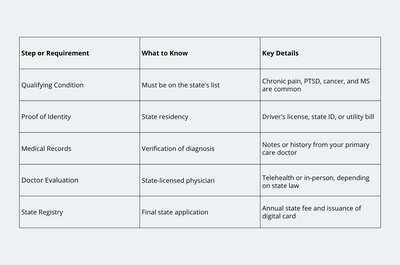
Medical Cannabis in the U.S.: What To Know
The table below captures what we've covered so far and can serve as a quick reminder.
FAQs
Can I qualify even though my condition isn’t on my state's list?
This depends on the state. Some states allow doctors to recommend medical marijuana for similar debilitating illnesses. Others only allow for the conditions listed.
Can a doctor prescribe marijuana for pain?
No. Doctors only recommend or issue a certificate, which you use to apply to your state's registry. They can't prescribe, as cannabis is still an illegal substance at the federal level.
Can a telehealth visit get me approved?
It depends on the rules of your state. Florida, Colorado, Alabama, and Kentucky insist on an in-person exam. In other states, however, it may be possible to get approved with an online consultation. You need to find out what the rules in your state are.
Final Thoughts
Navigating the medical cannabis system can feel overwhelming at first, but the information in this guide should make things a lot easier. If you're still having trouble getting into your state's registry, have an open conversation with a qualified doctor. They may know things you don't, and that can point you in the right direction.
S
Soft Secrets