Fungus Gnats and What You Need to Know
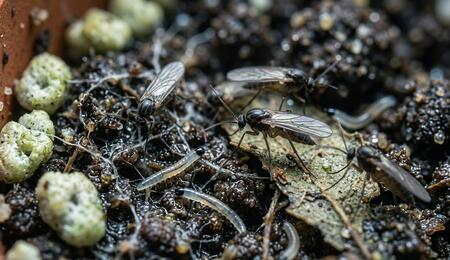
These tiny insects are particularly attracted to damp growing media, where their larvae can feed around plant roots and create conditions that leave cannabis plants stressed and vulnerable. Compared to spider mites, aphids or thrips, fungus gnats may seem harmless. Unlike many common cannabis pests, fungus gnats are not interested in feeding on leaves or buds. Instead, they spend much of their life cycle in the growing medium.
In this article, I will cover all you need to know about fungus gnats when growing cannabis, what to look for, how to get rid of them and precautions to take to prevent them from ever coming back!
What Are Fungus Gnats and Where Do They Come From?
Fungus gnats are one of many cannabis pests, however these tiny flying insects resemble miniature mosquitoes. Adult fungus gnats are usually around 2-4 mm long and have slender bodies, long legs, delicate wings and prominent antennae. Their larvae are very different in appearance. They resemble small, translucent worms with distinctive shiny black heads and live primarily in moist soil or other growing media.
The fungus gnat life cycle is relatively short. Under suitable conditions, eggs hatch into larvae, which develop before pupating and emerging as adults. This rapid reproduction means a small number of adults can quickly turn into a much larger infestation.
Fungus gnats are attracted to moist growing media containing organic matter. This makes indoor cannabis gardens particularly appealing, especially when plants are being watered frequently or the growing medium remains consistently damp.
Adult fungus gnats generally cause little direct damage to cannabis foliage. The greater concern is their larvae, which live around the roots and can contribute to root damage and plant stress. Fungus gnats thrive wherever they can find moisture and decaying organic material. Overwatering is therefore one of the most common reasons indoor grow becomes attractive to them.
Bagged or home made soil and other organic growing media can occasionally contain fungus gnat eggs or larvae before they even enter the grow room. Once introduced, consistently wet conditions can provide everything they need to reproduce. You may first notice adults flying close to the surface of your pots. Disturbing the upper layer of the growing medium can cause them to crawl out or take flight.
Although seeing a few adults doesn't necessarily mean your plants are in serious danger, it is worth investigating early. A small population is much easier to control than an established infestation containing multiple generations.
How to Identify Fungus Gnats In Your Soil
Fungus gnats lay their eggs in moist growing media. Because the eggs are extremely small, they are difficult to identify without close inspection. Instead of trying to find individual eggs, growers should look for the conditions that encourage them: consistently damp soil, organic matter and the presence of adult fungus gnats.
The larval stage is where fungus gnats can become problematic for cannabis plants. Larvae are small, translucent or whitish worms with a characteristic dark, shiny head. They are commonly found in the upper portion of damp growing media.
Carefully disturbing the top layer of soil can reveal larvae moving through the growing medium. Using a phone flashlight can also make them easier to spot, particularly when the soil is dark.
- Small larvae moving through damp soil
- Dark, shiny heads that are visible under a light
- Larvae concentrated in the upper 1–2 inches of growing media
- Slow or weak plant growth when populations become significant
Adults are usually the easiest stage to identify. They look like tiny black flies or miniature mosquitoes and are often seen flying close to the surface of pots. If you disturb the soil and several tiny flies suddenly emerge, there is a good chance fungus gnats are present. Because adults reproduce quickly, spotting them should prompt you to inspect the growing medium for larvae.
Can Fungus Gnats Cause Serious Cannabis Plant Root Damage?
Yes, they can and it all starts with larvae. Fungus gnat larvae are the main concern for cannabis plants. They live in the growing medium and feed on organic material, including material around the roots. A heavy infestation can interfere with healthy root development and leave plants more vulnerable to stress.
Young seedlings are particularly susceptible because their root systems are smaller and less established. These symptoms can easily be mistaken for watering problems or nutrient deficiencies. This is why checking the growing medium is important whenever an otherwise healthy cannabis plant suddenly begins to decline.
Fungus gnats do not necessarily cause mould simply by being present. However, both fungus gnats and several harmful plant pathogens favour similar environmental conditions. Persistently wet, poorly aerated growing media can encourage fungus gnats while also creating an environment in which root pathogens can thrive.
Diseases such as Pythium, Rhizoctonia, Fusarium and Phytophthora are associated with root and soil-related plant diseases. For this reason, discovering fungus gnats can be a useful warning sign that your growing medium may be staying wetter than it should.
How to Get Rid of Fungus Gnats
Once you identify an infestation, the most effective approach is to target both adult insects and larvae. Removing only the adults may provide temporary relief while larvae continue developing in the growing medium.
- Allow the growing medium to dry appropriately between waterings.
- Use yellow sticky traps to catch adult fungus gnats.
- Target larvae with suitable biological controls such as BTI or beneficial nematodes.
- Maintain good airflow around the surface of the growing medium.
- Avoid creating persistently wet conditions.
- Monitor plants and growing media regularly for signs of returning adults or larvae.
Once an infestation has been controlled, pest prevention is the best way to avoid another outbreak. The most important factor is moisture management. Avoid keeping the growing medium unnecessarily wet and allow the appropriate amount of drying between waterings.
Sticky traps can also be kept around the growing area as an early-warning system. If adults begin appearing again, you can respond before the population becomes established. A clean grow room floor is equally important.
Inspect new bags of growing media, pots and other materials before introducing them to your growing area. Keeping the grow room clean and removing dead organic material can also reduce potential breeding sites.
Some growers use diatomaceous earth as part of their pest-management strategy. When dry, this abrasive material can damage soft-bodied insects that come into contact with it. However, it should be treated as one part of an integrated approach rather than a standalone solution.
My Conclusion
Fungus gnats may be tiny, but an established infestation shouldn't be ignored. The adults are usually more of a nuisance than a direct threat, while the larvae can become problematic when they are present in large numbers around developing roots.
The key to successful control is identifying the problem early and addressing both stages of the infestation. Allowing the growing medium to dry appropriately, using yellow sticky traps, targeting larvae with suitable biological controls and maintaining good airflow can all help reduce fungus gnat populations and fight off other pathogens such as mould or powdery mildew.
Most importantly, prevention starts with moisture management. If you can avoid keeping your growing medium consistently wet, you can make your cannabis garden considerably less attractive to fungus gnats in the first place. Keep your grow room clean and tidy, monitor the soil and foliage daily and keep a close eye on your roots!
S
Stoney.Tark